


As the Trump administration seeks greater control over NIH funding of HIV research, Lynda Dee, now 74, is pressing Congress to protect the research networks that activists helped build
Anyone who’s worked in HIV/AIDS treatment activism in the past 40 years either knows or has at least heard of Lynda Dee, now 74. She’s an outspoken, unfiltered Baltimorean, a lawyer by training and cofounder of AIDS Action Baltimore who remains its executive director. And she’s still in the fight.
Dee is among the HIV activists who are urging members of Congress to push back against a Trump administration efforts to divert money intended for the National Institutes of Health (NIH) or subject NIH grants to review by a panel of political appointees.
A proposed agreement would take congressionally approved NIH research funding and redirect it to military priorities. Sen. Patty Murray (D-Wash.) has warned that the agreement could give the Pentagon access to billions of dollars intended for the National Institute of Allergy and Infectious Diseases (NIAID), which supports HIV research. Administration officials deny the charge, describing the agreement as a research partnership rather than a raid on medical research funding.
Treatment activists are also leading the charge to protect research dollars and keep decisions about how to spend the money grounded in science. Advocates are urging Congress to block efforts to give political appointees greater control over NIH grant-making.
The Save HIV Funding campaign, a loose national coalition of activists that includes Dee, is urging the public to contact their U.S. senators and House members to demand that the Department of Health and Human Services (HHS) release months-overdue NIH notices of funding opportunity (NOFOs)—announcements inviting researchers to apply, and compete, for grants that support HIV research. NIAID competitively renews its core HIV/AIDS clinical trials networks on a strict seven-year cycle.
The campaign warns that delaying release of these NOFOs could threaten grant renewals for the HIV/AIDS Clinical Trials Networks and Centers for AIDS Research, which could interrupt ongoing clinical trials, dismantle research infrastructure and waste billions in taxpayer investment.
A web page set up by the advocacy group PrEP4All lets visitors send a message to all three of their elected members (both senators and one representative) that is already written or can be customized to personalize the message with your own lived experience. Visitors can contact their senators and House members here.
In late September, Sen. Susan Collins (R-Maine) said congressional pressure had persuaded the White House to drop a proposed executive order that would have subjected all NIH research grants to the review and veto power of a commission of political appointees. Such a commission likely would have axed any grants considered by the Trump White House to have a “far-left,” “woke” or “DEI” [diversity, equity and inclusion] agenda, yet such studies often examine social determinants of health that disproportionately affect marginalized groups such as Black and LGBTQ+ people.
The victory—for now—was welcome news, but Dee says the White House is still seeking other ways to exert more control over research funding that should be left in the hands of health experts.
Dee has been in the trenches since the 1980s, when her husband, a gay man, died from complications of AIDS and many gay friends also became seriously ill or died. Since then, she has fought for women and people of color to be included in clinical trials and for treatments to be accessible once they reach the market.
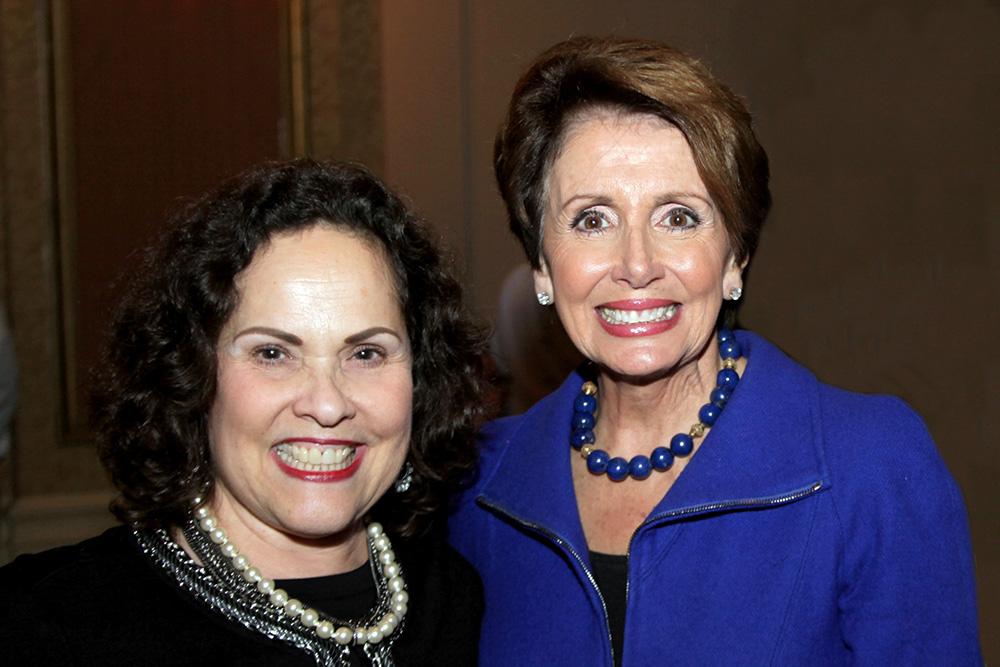
Lynda Dee with then-Speaker of the House Nancy Pelosi
In this interview, she talks about the current battle in more depth, and about her journey from gay-guy-loving party girl to treatment and research expert.
Lynda, thanks for catching up with us today. Can you start by listing the groups you’re working with in addition to being executive director of AIDS Action Baltimore (AAB)?
I’m a board member of AIDS Treatment Activists Coalition [ATAC], which meets with drug companies and whose other members include Rick Guasco [POSITIVELY AWARE’s editor-in-chief], Jeff Berry, Moisés Agosto-Rosario, Derrick Mapp, Matt Sharp and Murray Penner. I’m also the community engagement coordinator for Delaney AIDS Research Enterprise [DARE], which is named for late treatment activist Martin Delaney and promotes research toward a cure for HIV, and I’m a member of the International AIDS Society’s Industry Collaboratory Group, or ICG.
So, what role are you playing in terms of trying to keep the Trump administration’s hands off federally funded HIV/AIDS research, like at the NIH?
I’m the NIH girl, and I always have been, along with people from Treatment Action Group [which started in the early ’90s as an offshoot from ACT UP]. I know both NIH and the FDA [Food and Drug Administration] like the back of my hand. When things go wrong, I have a lot of friends there. Some have been fired [by the Trump administration] and some are still there. But I get all the dirt. I feel like [legendary Watergate investigative journalist Carl] Bernstein at this point.
So when Trump took office again [and began slashing federally funded research], I knew that the HIV trial networks we’ve helped build over decades—including AIDS Clinical Trials Group [ACTG], HIV Vaccine Trials Network [HVTN], HIV Prevention Trials Network [HPTN] and International Maternal Pediatric Adolescent AIDS Clinical Trials Network [IMPAACT Network]—were going to be targeted.
So the NOFOs NIH announcements inviting researchers to apply, and compete, for grants to support HIV research for the [clinical] trial networks, as well as for the 19 CFARs [Centers for AIDS Research], were supposed to come out in May, and then in August, but they’ve been delayed. As of today [September 24], they’re still not out. And the current funding runs out at the end of next year. So it’s really not good that researchers haven’t had the chance yet to apply for the next cycle of funding.
About 10 days ago, the NOFOs were approved by the NIH, and now they’re parked at HHS, where, if approved, they move back to the Division of AIDS [DAIDS] to get released. So we’re months behind.
Meanwhile, according to Senator Collins, the proposed executive order that would give White House political appointees veto power over all government funding has been paused by Congress via the continuing resolution that is currently funding the government, but that’s only through December 11.
Meanwhile, it seems that the White House was trying to move money that Congress appropriated for HIV and other [infectious disease] research to the Department of Defense [DOD], which is a black hole in terms of what happens to funding that’s moved there. Historically, DOD does a lot of good work [around HIV and other diseases], but we’ve never been able to penetrate it. That effort got stopped and seems to have gone away.
But Russell Vought [a leading architect of Trump’s grab for presidential power; Vought is director of the White House’s Office of Management and Budget, OMB, slashing federal funding for global and domestic health and social services] is an evil genius, so now we don’t know what he’ll do next. He could resurrect the effort to move money to DOD, because they want our money—congressionally approved money! If that money goes to DOD, we’re probably not going to be able to find out if it actually went to HIV and other health research.
But I also think the White House is going to wait for the midterm elections to be over before they try more stuff, because they don’t want to make waves right now.
Wow, a lot of moving parts to these assaults on research funding. What happens if Democrats take back the House and maybe even the Senate in November?
Then we’ll be in OK shape to ask Congress to pass legislation that permanently prevents OMB from [exerting veto control over the grant-giving process]. More broadly, we probably won’t have big enough majorities in Congress to override Trump vetoes of bills he doesn’t like, but we’ll have more negotiating power. We have strong HHS advocates in Congress, and we’re also working with behind-the-scenes advocates.
Even if Democrats win a congressional majority, reversing the past two years of White House changes to domestic and global health programs, social research and services will take time.
It’s going to take 40 years to undo what they’ve done. We’re just trying to hold onto what’s left. If these HIV trial networks go away, they’re not coming back. It took 40 years for the ACTG to be what it is. Look at all they’ve done! It’s the best infectious diseases trial network that’s ever existed. How do you rebuild that? How do we work with countries that hate us because we just made them dump their people off trials that were underway? Will they ever trust us again?
What is the advocacy plan moving forward?
We’re preparing Save HIV Funding talking points to convince members of Congress on the appropriations committees to make sure right this minute that HHS approves those NOFOs [so the competition for the next cycle of grants can get underway] before researchers run out of their current funding. [Health secretary and Trump ally] Robert F. Kennedy, Jr. doesn’t want HHS to approve it, and all Vought needs to do is call up RFK and say, “Don’t approve this.” So we have to overcome that with congressional pressure. That’s the only thing that has stopped a million different things Trump has tried to do.
We have a lot of good allies on the appropriations committees, like Rep. Rosa DeLauro [D-Conn.] and Sen. Patty Murray. And we should have even more, because every one of these states, including the red ones, have giant universities that the NIH is paying millions of dollars to.
If we can get personal now, how did HIV/AIDS advocacy become your life's work?
I was a party girl. We’d get all cranked up on meth on weekends and start out in Baltimore, then drive to Philly, then to [iconic 1980s gay megaclub] The Saint in NYC, and then they’d sweep us out with the trash at [NYC leather/sex bar] The Anvil on Monday morning.
I knew everyone and everyone knew me. Someone once said of me, Miss Dee? She’s a famous hag! They loved me and I loved them. And I loved them because, when I was a heroin addict at 17 or 18, and arrested at 18 with 43 bags of heroin, I needed another crowd to hang out with, and those boys just loved me and couldn’t have been more fun. They became my best friends. We partied!
And what about your husband?
His name was Barron Lafield. He was of French descent from Louisiana. He was one of those queers where you wonder, How does he come from this family of hillbillies? I met him on a corner when he and his lover were dropping off their boyfriend from the night before, so I knew from Day One that he was gay. But he fell in love with me, and I with him.
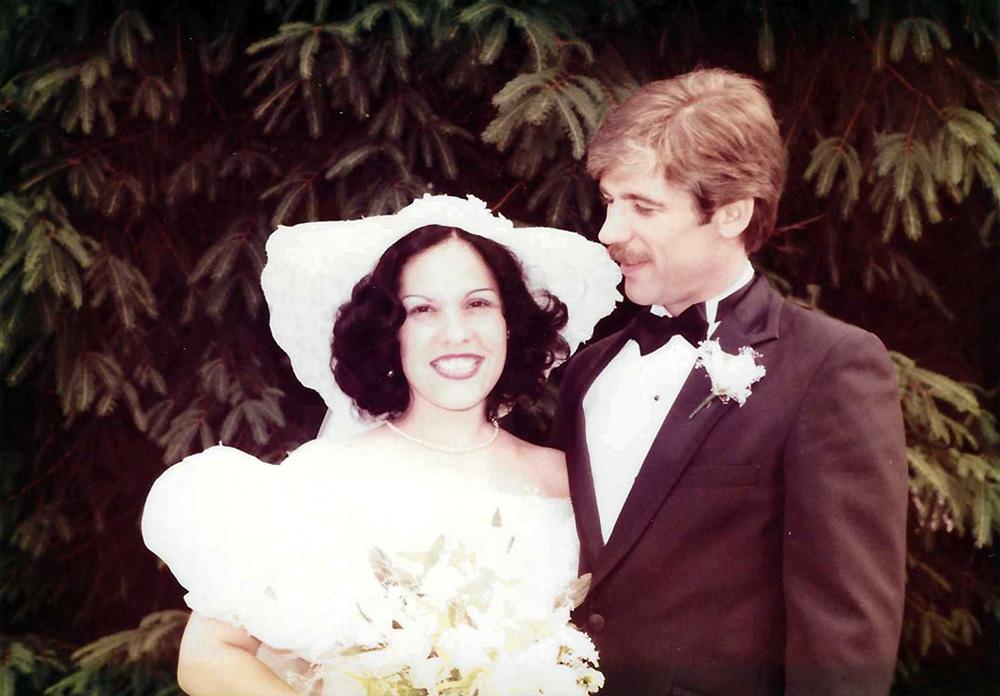
Dee with husband Barron Lafield, 1984
And then everyone started dying. I was like, I’m not letting this happen! It wasn’t all altruism. I had a plan for these boys to be with me for the rest of my life! I thought, if we as a country can send a man to the moon, we can fix this [AIDS crisis].
Can I ask if your husband transmitted HIV to you?
He didn’t. But we did have a son together who died from SIDS [sudden infant death syndrome] when he was six weeks old.
Oh, Lynda, I didn’t know that. I’m so sorry.
When my husband was diagnosed with AIDS, we separated and he went back to Louisiana first. When he got histoplasmosis [an AIDS-related lung infection], no other division in the charity hospital there would take him, so they put him in the wet-brain unit [slang for where patients with severe, chronic alcohol-related brain damage are treated]. They actually stuck him in a closet all by himself.
So I brought him back up to Baltimore so he could get care at Johns Hopkins. Then he told me to go to The Saint in NYC for Halloween 1986. So I’m there with my friends and we’re partying out of our minds when The Saint staff tells me there’s a call for me. It’s from the E.R. at Hopkins: We don’t know what’s wrong with him, so we have to do exploratory surgery—you better come home because we don’t know if he’ll survive the surgery.
So I get back to Hopkins, and they cut him from his tits down to his pubes. He had what looked like a basketball of histoplasmosis fungus inside of him. He had to take amphotericin B every day for 20 hours for the rest of his life, which ended when he got Kaposi sarcoma [a form of skin cancer that was an end stage AIDS-defining illness at the time], which finally killed him in 1987.
How did you respond to his death?
When somebody is that sick, you can’t sit around and cry, Oh my God, he’s going to die! You can only do the next right thing. I mean, was I anxious? I’m anxious all the time! I’m very manic, if you haven’t been able to figure that out. He was in the hospital nine times in the final 10 months of his life. Whenever he was there, I’d also have another friend there [with AIDS complications]. I was always running into the bathroom to smoke a joint, painting my fingernails, running from room to room. I got to know every one of the doctors who dealt with HIV. I was smart and curious, and I understood everything they were talking about. These were things that motivated me to [work toward] having [research systems] in place to save these guys’ lives.
So then Pat Moran, Garey Lambert and I started AIDS Action Baltimore. We knew we had to be involved with research. I’d read John James’ newsletter AIDS Treatment News. I’d go to the NYC ACT UP meetings and listen to what was going on. When [ACT UP-turned-TAG cofounders] Mark Harrington and Gregg Gonsalves started putting out reports about the NIH, I read them and thought, Oh my God, these guys are so brilliant—I wanna know everything they know! Mark and I became fast friends, and we’ve been partners in crime ever since.
Eventually I made it onto the Opportunistic Infections (OI) committee of ACTG. We started our own pentamidine [an inhaled medication to prevent PCP pneumonia, one of the most common AIDS-related opportunistic infections] program at AAB. We got this queer doctor to help us run it.
And you’ve had a hand in every major HIV/AIDS treatment and research development ever since. What are your biggest triumphs?
Well, we saved a lot of lives with that pentamidine program. And when I was on the OI committee, we got them to streamline clinical trials to get better answers faster. We did a lot of FDA stuff, too. I’m proud of the role I had in changing trial design so that it didn’t take 12 years to approve a drug.
I’m proud of the expanded access programs we pressured drugmakers to open so that more people could access an investigational drug than just those who fit the narrow trial criteria. Also, when it was brought to my attention by Mark Milano [a longtime fellow treatment activist who died three days into 2026] that the info for drugmakers’ patients assistance programs [PAPs] was so obscure, we got every HIV and hep C drugmaker to have exactly the same PAP criteria, and to include info on how to access them on their websites’ front pages.
I’m also proud that AAB paid for the fluconazole [an antifungal drug] when generic drugs became available in South Africa for people with HIV, due to the work of Treatment Action Campaign [a South African activist group].
And I’m proud of testifying at the congressional briefing last year to save NIH funding and this year to save the trial networks and the CFARs.
What have been your biggest disappointments?
Not a lot! When I put my mind to something, I fucking do it! When we [activists] first got involved with ACTG, the medical leadership thought we were from Mars. It took them years to see the value we brought. But when I got involved in cure research about 10 years ago, I had to start all over again. They were like, What do we need you for? What do you know about this? How dare you tell us what to do? Those trials didn’t even have community advisory boards—I made them get them!
Have you parted ways since then?
With some of them. The women researchers appreciate us the most. A lot of researchers are now using this We hate community to ignore and avoid us.
What’s been the most challenging aspect of your work?
Dealing with the boys in the community, having to prove myself to a lot of pompous asses, which isn’t easy. I won most of the boys over, but not all of them.
Did you meet women living with HIV in Baltimore?
There was a woman down here who was dealing with women [who were living with HIV], so it was her territory. But I still went to every single approval hearing for an HIV drug because I lived nearby. I went in myself, screaming for people of color and women to be in trials.
After all these triumphs and challenges, how are you feeling about the moment we’re in with this administration?
I feel like a manic-depressive. One minute, I feel like, I’m gonna take ’em all down! The next, I turn on the news and want to give up. Then I wake up and have an idea and decide, OK, I’m gonna call so-and-so. And I try again. I’m from the Never SurrenderSchool. As long as I’m alive, I’m going to do what I can to make sure these trial networks survive.
Beyond the HIV stuff, what do you do to chill out?
I never chill out. I’m still with my boys—what’s left of them, and a lot are left. I have friends all over the world. I like to do cultural stuff—ballet, opera, movies, going out to dinner. I just do it with queers instead of straight people. I just came back from London, where we saw the [immersive] David Bowie light show on three giant walls. I love David Bowie.
I love to travel, even though my knees and ankles are giving. So I’m going on a cruise soon. Not a gay cruise. Just a regular cruise.
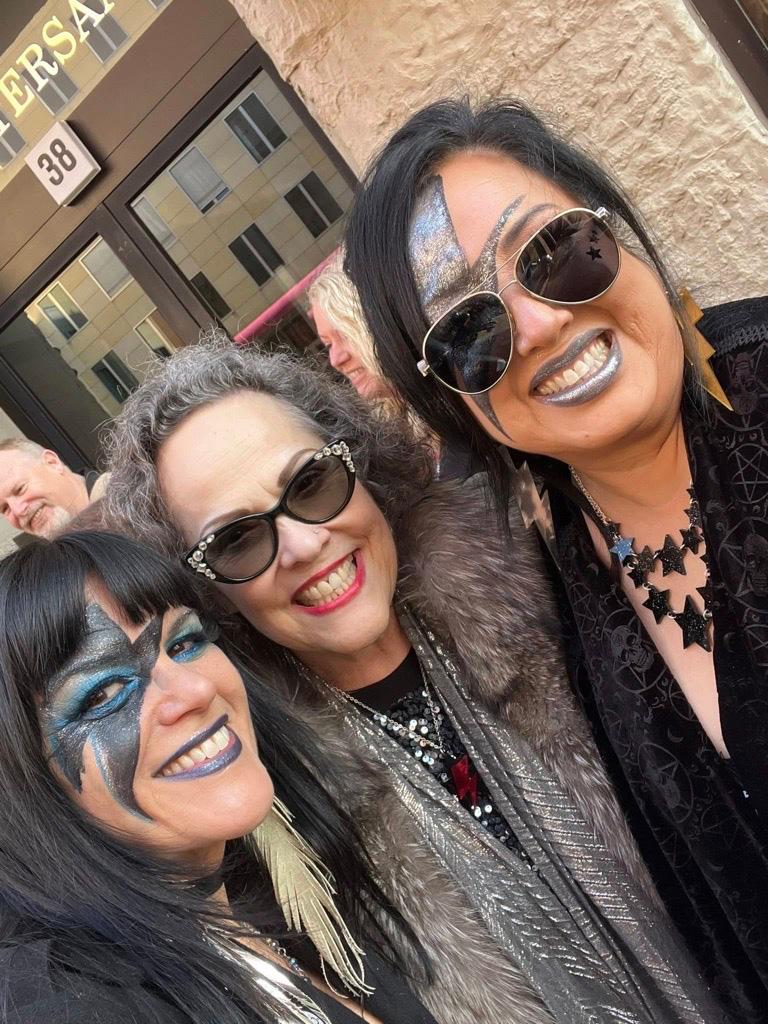
Dee in 2024 with her girlfriends outside the studio in Berlin where David Bowie’s “Heroes” was recorded